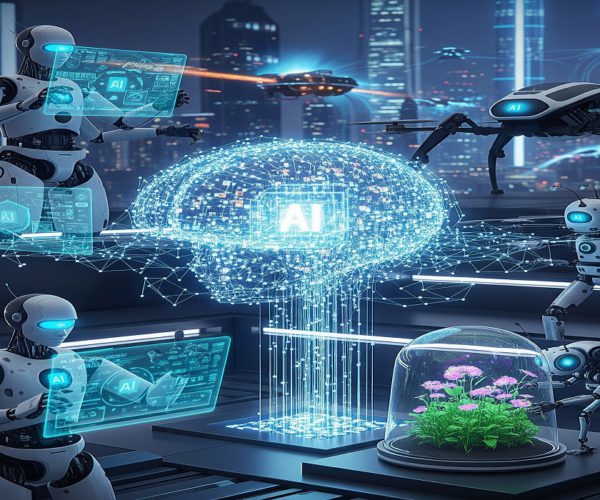
The rapid evolution of artificial intelligence has given rise to a groundbreaking innovation: autonomous AI agents. These advanced systems can independently perceive, reason, plan, and execute tasks without constant human intervention. From automating business workflows to revolutionizing customer service, autonomous AI agents are set to transform industries and redefine human-machine collaboration.
What Are Autonomous AI Agents?
Autonomous AI agents are self-directed AI systems capable of:
-
Perceiving their environment via sensors, data inputs, or APIs.
-
Reasoning using machine learning (ML) and large language models (LLMs).
-
Planning and making decisions based on predefined goals.
-
Acting by executing tasks, interacting with other systems, or communicating with users.
Unlike traditional AI, which requires explicit instructions, autonomous agents operate dynamically, learning and adapting in real time.
Key Features of Autonomous AI Agents
-
Self-Learning & Adaptation
-
Continuously improve performance using reinforcement learning (RL) and feedback loops.
-
Adjust strategies based on new data or changing environments.
-
-
Multi-Agent Collaboration
-
Work alongside other AI agents or humans in a coordinated manner.
-
Example: Supply chain optimization where multiple AI agents manage logistics, inventory, and demand forecasting.
-
-
Goal-Oriented Autonomy
-
Operate with minimal supervision to achieve specific objectives.
-
Example: An AI sales agent that autonomously qualifies leads, schedules meetings, and follows up.
-
-
Real-Time Decision Making
-
Process vast amounts of data instantly to make informed choices.
-
Used in high-frequency trading, autonomous vehicles, and emergency response systems.
-
Applications of Autonomous AI Agents
1. Business & Enterprise Automation
-
AI Employees: Handle customer support (e.g., AI agents resolving 90% of queries without human help).
-
Autonomous Process Optimization: Automate complex workflows in finance, HR, and operations.
2. Healthcare & Research
-
AI Doctors: Assist in diagnostics, treatment recommendations, and robotic surgeries.
-
Drug Discovery: Autonomous AI labs simulate and test millions of molecular combinations.
3. Smart Cities & IoT
-
Traffic Management: AI agents optimize traffic lights in real time to reduce congestion.
-
Energy Grids: Self-managing systems balance power distribution using predictive analytics.
4. Personal AI Assistants
-
Hyper-Personalized Agents: Manage schedules, finances, and even negotiate deals on behalf of users.
-
AI Companions: Provide emotional support, tutoring, or fitness coaching.
5. Defense & Cybersecurity
-
Autonomous Cyber-Defense: Detect and neutralize threats faster than human teams.
-
Military Drones & Robotics: AI-powered agents execute reconnaissance and tactical missions.
Challenges & Ethical Considerations
While autonomous AI agents offer immense potential, they also raise critical concerns:
-
Safety & Control: Ensuring agents operate within ethical boundaries.
-
Bias & Fairness: Preventing AI from reinforcing harmful stereotypes.
-
Job Displacement: Managing workforce transitions as AI takes over repetitive roles.
-
Regulation & Accountability: Establishing legal frameworks for AI decision-making.
The Future of Autonomous AI Agents
By 2025-2030, we can expect:
-
AGI (Artificial General Intelligence) Breakthroughs: AI agents with near-human reasoning.
-
Ubiquitous AI Ecosystems: Every industry will deploy autonomous agents for efficiency.
-
Human-AI Symbiosis: Seamless collaboration where AI augments human capabilities.
Conclusion
Autonomous AI agents represent a paradigm shift in technology, offering unprecedented efficiency and innovation. Businesses and individuals must prepare for this AI-driven future by embracing automation while addressing ethical and security challenges.
#AutonomousAI #AI #ArtificialIntelligence #MachineLearning #AIagents #Automation #FutureTech #AGI #TechTrends #DigitalTransformation #AIAssistants #Robotics #SmartCities #Cybersecurity