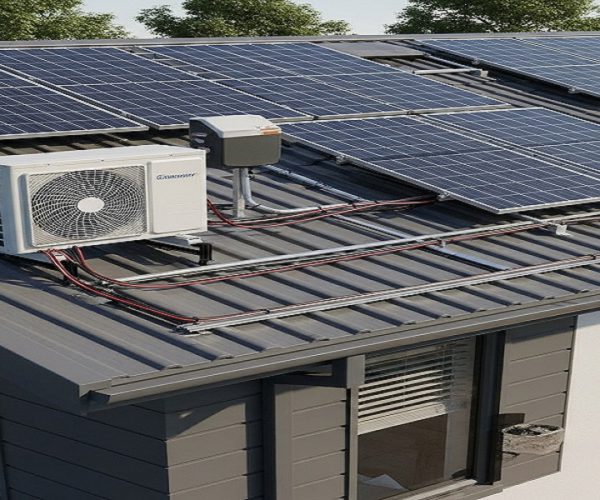
Building a solar setup to power an air conditioning (AC) unit requires careful planning, as ACs consume a significant amount of electricity. Below is a step-by-step guide to help you design and install a solar system capable of running an AC unit.
Step 1: Determine Your AC’s Power Requirements
Before designing your solar system, you need to know how much power your AC consumes.
- Check the AC’s nameplate or manual for:
- Running Watts (e.g., 1,000W for a small unit, up to 3,500W for a large one).
- Starting Surge (if applicable, typically 1.5–3x running watts for inverter ACs, higher for conventional units).
- Voltage (usually 120V or 240V).
- Calculate daily energy consumption:
- If your 1,500W AC runs for 8 hours/day:
1,500W × 8h = 12,000Wh (12 kWh/day).
- If your 1,500W AC runs for 8 hours/day:
Step 2: Size Your Solar Panel Array
Solar panels must generate enough energy to cover your AC’s needs, accounting for inefficiencies.
- Estimate daily sunlight hours (e.g., 5 peak sun hours/day).
- Calculate required solar panel wattage:
- Total Wattage Needed = Daily Consumption ÷ Sunlight Hours ÷ Efficiency Loss (0.8)
Example: 12,000Wh ÷ 5h ÷ 0.8 = 3,000W (3 kW) of solar panels.
- Total Wattage Needed = Daily Consumption ÷ Sunlight Hours ÷ Efficiency Loss (0.8)
- Choose panels (e.g., ten 300W panels or six 500W panels).
Step 3: Select a Battery Bank (For Off-Grid or Backup)
If you want to run the AC at night or during cloudy days, you’ll need batteries.
- Determine usable battery capacity (lead-acid = 50% depth of discharge, lithium = 80%).
- For 12 kWh/day with lithium:
12,000Wh ÷ 0.8 = 15,000Wh (15 kWh) battery bank.
- For 12 kWh/day with lithium:
- Choose battery voltage (typically 24V or 48V for larger systems).
- Pick batteries (e.g., four 5kWh lithium batteries at 48V).
Step 4: Choose an Inverter
The inverter converts DC (from panels/batteries) to AC for your air conditioner.
- Match inverter voltage to battery bank (e.g., 48V).
- Ensure continuous wattage rating exceeds AC’s running watts (e.g., 3,000W inverter for a 1,500W AC).
- Account for surge power (if your AC has a high startup surge, choose an inverter with a higher surge rating).
- Type of inverter:
- Off-grid: Requires batteries.
- Hybrid: Can use grid + solar.
- Grid-tied: No batteries but may not work during outages.
Step 5: Charge Controller (For Battery Systems)
If using batteries, a charge controller regulates power from panels to batteries.
- Type:
- PWM (cheaper, less efficient).
- MPPT (more efficient, especially for larger systems).
- Sizing:
- Current = Solar Array Wattage ÷ Battery Voltage
Example: 3,000W ÷ 48V = 62.5A → Choose a 70A MPPT controller.
- Current = Solar Array Wattage ÷ Battery Voltage
Step 6: Wiring and Safety Components
- Cables: Use thick, low-resistance cables (e.g., 4 AWG for high-current connections).
- Fuses/breakers: Install between:
- Solar panels and charge controller.
- Battery and inverter.
- Grounding: Essential for safety.
Step 7: Installation
- Mount solar panels on a roof or ground mount (south-facing in the Northern Hemisphere, tilt angle optimized for your latitude).
- Connect components in this order:
- Panels → Charge Controller → Battery Bank → Inverter → AC Unit.
- Test the system with a multimeter before connecting the AC.
Step 8: Monitor and Maintain
- Monitor energy production/consumption (some inverters have built-in monitoring).
- Clean panels periodically.
- Check battery levels (if applicable).
Example Setup for a 1,500W AC
- Solar Panels: 3,000W (10 × 300W panels).
- Battery Bank: 15 kWh lithium (48V).
- Inverter: 3,000W pure sine wave (48V, 6,000W surge).
- Charge Controller: 70A MPPT.
- Wiring: 4 AWG copper cables, 150A fuses.
Additional Tips
- Consider an inverter AC (more efficient, lower startup surge).
- For grid-tied systems, check local net metering policies.
- If your AC is 240V, ensure the inverter supports it.
- Start small (e.g., power just the AC during the day) to reduce costs.
Solar-Powered AC System Diagram
┌───────────────────────────────────────────────────────────────┐
│ SOLAR POWER SYSTEM │
├─────────────────┐ ┌─────────────────┐ ┌─────────────┤
│ SOLAR PANELS │ │ BATTERY │ │ AC UNIT │
│ (3000W Total) │───────▶ BANK (48V) │──────▶ (1500W-240V)│
└────────┬────────┘ └────────┬────────┘ └─────────────┘
│ │
▼ ▼
┌─────────────────┐ ┌───────────────────┐
│ CHARGE │ │ INVERTER │
│ CONTROLLER │ │ (3000W Pure Sine) │
│ (MPPT, 70A) │──────▶ (48V DC → 240V AC) │
└─────────────────┘ └───────────────────┘
▲
│
┌─────────────────┐
│ DC DISCONNECT │
│ (FUSE/BREAKER) │
└─────────────────┘
Key Components & Connections
- Solar Panels (3,000W Total)
- Connected in series/parallel to match charge controller voltage (e.g., 48V).
- Wire gauge: 10 AWG (for panels) → 4 AWG (for main DC lines).
- Charge Controller (MPPT, 70A)
- Regulates power from panels to batteries.
- Critical: Ensure max input voltage (Voc) of panels < controller limit.
- Battery Bank (48V, 15kWh Lithium)
- Stores energy for nighttime/cloudy days.
- Fused (e.g., 150A breaker) between battery and inverter.
- Inverter (3,000W Pure Sine Wave, 48V → 240V AC)
- Converts DC to AC. Must handle AC’s startup surge (if any).
- Directly powers the AC unit.
- AC Unit (1,500W, 240V)
- Preferably an inverter-type AC (efficient, low surge).
- Safety Components
- DC disconnect switch (between panels and charge controller).
- Fuses/breakers on all high-current paths.
- Grounding for panels/inverter/batteries.
Wiring Steps
- Solar Panels → Charge Controller
- Connect panels in series/parallel to reach ~48V (e.g., 4 panels in series × 12V each).
- Use 10 AWG solar cables with MC4 connectors.
- Charge Controller → Battery Bank
- Heavy-duty 4 AWG cables (short runs to minimize voltage drop).
- Battery Bank → Inverter
- 4 AWG or thicker cables (3,000W at 48V = ~62.5A).
- Inverter → AC Unit
- Standard 240V AC wiring (follow local electrical codes).
Optional Add-Ons
- Automatic Transfer Switch: For hybrid systems (switches to grid if solar/battery is low).
- Monitoring System: Tracks solar production/battery levels (e.g., Victron BMV).
Visual Sketch
For a more detailed visual, you can use tools like:
- DIY Sketch: Draw it out based on the blocks above.
- Software: Use SolarDesignTool, PVsyst, or even Microsoft Visio.
Would you like a more detailed schematic with wire colors/sizes or a recommendation for component brands?
okay please
Here’s a detailed schematic with wire sizes, safety components, and recommended brands for a 3,000W solar system powering a 1,500W AC unit (240V).
Detailed Solar AC System Schematic
┌─────────────────────────────────────────────────────────────────────┐
│                        OFF-GRID SOLAR SYSTEM (48V)                  │
├───────────────────┐   ┌───────────────────┐   ┌───────────────────┐
│  SOLAR PANELS     │   │   CHARGE          │   │   LITHIUM         │
│  (10x 300W)       │   │   CONTROLLER      │   │   BATTERIES       │
│  Series-Parallel  │──▶│   (MPPT, 70A)     │──▶│   (4x 5kWh, 48V)  │
│  Voc: ~96V        │   │   Victron SmartSolar │   │   EG4 or Battle Born│
└────────┬──────────┘   └────────┬──────────┘   └────────┬──────────┘
         │                       │                        │
         ▼                       ▼                        ▼
┌───────────────────┐   ┌───────────────────┐   ┌───────────────────┐
│   DC DISCONNECT   │   │   BATTERY FUSE    │   │   INVERTER        │
│   (63A Breaker)   │   │   (150A Class T)  │   │   (3,000W 48V)    │
│   Midnite Solar   │   │   Blue Sea Systems│   │   Victron MultiPlus│
└────────┬──────────┘   └────────┬──────────┘   └────────┬──────────┘
         │                       │                        │
         ▼                       ▼                        ▼
┌───────────────────┐   ┌───────────────────┐   ┌───────────────────┐
│   GROUND BUS BAR  │   │   SHUNT METER     │   │   AC DISCONNECT   │
│   (Lightning/ESD) │   │   (Victron BMV)   │   │   (30A Breaker)   │
└───────────────────┘   └───────────────────┘   └────────┬──────────┘
                                                         │
                                                         ▼
                                                  ┌───────────────────┐
                                                  │   AIR CONDITIONER │
                                                  │   (1,500W 240V)   │
                                                  │   Inverter-Type   │
                                                  └───────────────────┘
Key Details & Recommendations
1. Solar Panels (3,000W Total)
- Configuration: 5S2P (5 panels in series × 2 parallel strings).
- *Each 300W panel: Voc=40V, Vmp=32V → 5S = 200V Voc (safe for 150V max controllers)*.
- Cables:
- Panel to Combiner Box: 10 AWG PV wire (UV-resistant).
- Combiner to Charge Controller: 8 AWG (for 96V/40A).
- Recommended Brands:
- Panels: Canadian Solar, REC, or Qcells (300W+).
- Combiner Box: Midnite Solar MNPV6 (with breakers).
2. Charge Controller (MPPT, 70A)
- Input: Max 150V, 70A output (3,000W ÷ 48V = 62.5A).
- Cables: 6 AWG (charge controller to battery).
- Recommended:
- Victron SmartSolar 250/70 (best efficiency).
- Budget: EPEver Tracer 6415AN.
3. Battery Bank (48V, 15kWh)
- Configuration: 4x 48V 5kWh lithium batteries in parallel.
- Cables: 2/0 AWG (battery to inverter).
- Recommended:
- EG4 LL-S 48V 100Ah (cheaper) or Battle Born 48V (premium).
4. Inverter (3,000W Pure Sine Wave)
- Surge Capacity: 6,000W (for AC startup).
- Cables: 2/0 AWG (battery to inverter).
- Recommended:
- Victron MultiPlus 48V/3000VA (hybrid capability).
- Budget: Giandel 3,000W 48V.
5. Safety Components
- DC Disconnect: Midnite Solar 63A breaker (between panels/charge controller).
- Battery Fuse: 150A Class T (between battery/inverter).
- AC Disconnect: 30A double-pole breaker (inverter to AC unit).
- Grounding: 6 AWG bare copper wire to grounding rod.
6. Monitoring
- Victron BMV-712 (battery state of charge).
- SmartShunt (optional for Bluetooth monitoring).
Wiring Color Guide
- Solar (+): Red (10 AWG).
- Solar (-): Black (10 AWG).
- Battery (+): Red (2/0 AWG).
- Battery (-): Black (2/0 AWG).
- Ground: Green/bare (6 AWG).
Tools You’ll Need
- Wire Crimpers (for lugs).
- Multimeter (to check voltage/current).
- Conduit (for outdoor cable protection).
Final Notes
- Permits: Check local codes for grid-tied/hybrid systems.
- Efficiency: Use an inverter-type AC (e.g., Midea U-Shaped) to reduce surge.
- Scalability: Add more panels/batteries later if needed.
Here’s a complete shopping list with links (where available) for building a 3,000W solar system to power a 1,500W AC unit. Prices are approximate and vary by region.
Core Components
1. Solar Panels (3,000W Total)
- Option 1 (Budget): Canadian Solar 300W Panel (~$180 each)
- Qty: 10 panels (5S2P for 48V system).
- Option 2 (Premium): REC Alpha Pure 400W (~$300 each)
- Qty: 8 panels (4S2P).
2. Charge Controller (MPPT, 70A)
- Victron SmartSolar 250/70 (Amazon) (~$550)
- Budget Alternative: EPEver Tracer 6415AN (~$320)
3. Battery Bank (48V, 15kWh Lithium)
- EG4 LL-S 48V 100Ah (5kWh) (Signature Solar) (~$1,500 each)
- Qty: 3 (15kWh total).
- Premium Option: Battle Born 48V 100Ah (~$3,000 each)
4. Inverter (3,000W Pure Sine Wave, 48V)
- Victron MultiPlus 48V/3000VA (Current Connected) (~$1,800)
- Budget Option: Giandel 3,000W 48V (~$700)
Safety & Wiring
5. Combiner Box & Breakers
- Midnite Solar MNPV6 Combiner Box (Amazon) (~$200)
- 15A DC Breakers (for each string) ([Amazon](https://www.amazon.com/MidNite-Solar-MNEDC-15- Circuit-Breaker/dp/B005LDC4OE)) (~$20 each)
6. Fuses & Disconnects
- 150A Class T Fuse (Blue Sea Systems) (~$50)
- 63A DC Disconnect (Midnite Solar) (Amazon) (~$60)
- 30A AC Disconnect (for inverter output) (Amazon) (~$20)
7. Cables & Lugs
- Solar Panel Cables (10 AWG, MC4 Connectors) (Amazon) (~$50)
- Battery Cables (2/0 AWG, Red/Black) (Amazon) (~$100 for 20ft)
- Copper Lugs (2/0 AWG, Crimp-On) (Amazon) (~$30)
8. Grounding & Mounting
- 6 AWG Bare Copper Ground Wire (Home Depot) (~$30)
- Solar Panel Mounting Rails (IronRidge) (~$200 for 10 panels)
Monitoring & Extras
9. Battery Monitor
- Victron BMV-712 (Amazon) (~$180)
10. Tools
Total Estimated Cost (Before Tax)
| Category | Budget Option | Premium Option |
|---|---|---|
| Solar Panels | $1,800 | $2,400 |
| Charge Controller | $320 | $550 |
| Batteries | $4,500 | $9,000 |
| Inverter | $700 | $1,800 |
| Safety/Wiring | $500 | $600 |
| Total | $7,820 | $14,350 |
Where to Buy
- Solar Panels/Combiner Boxes: Amazon
- Batteries/Inverters: Signature Solar
- Cables/Tools: Amazon or Home Depot
Final Notes
- DIY vs. Professional Install: If unsure, hire an electrician for high-voltage (48V+) connections.
- Permits: Check local laws for grid-tied systems.
- Scalability: Add more panels/batteries later if needed.